
novelgroup.lu

Categories
News

EVTA Community Meetup: Exploring Digital Innovation in VET

EVTA Community Meetup: Exploring Digital Innovation in VET

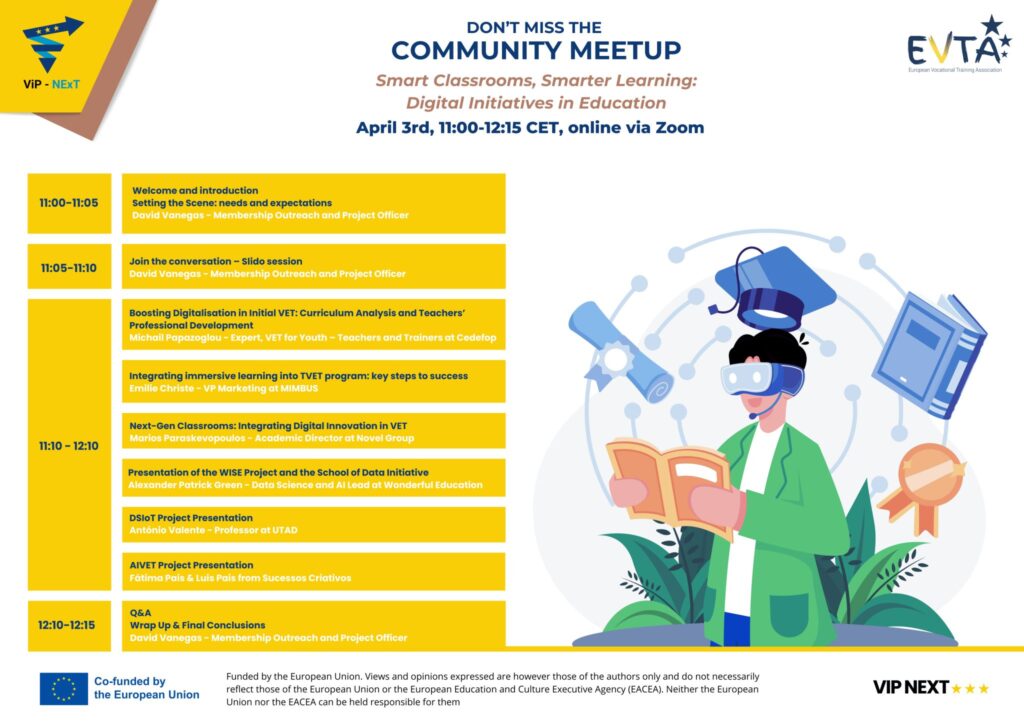
The second EVTA Community Meetup will take place on April 3rd from 11:00 – 12:15 CET. This online event will focus on the integration of digital tools in vocational education and training (VET), highlighting how emerging technologies are transforming the future of learning.

As part of the EVTA ViP-NExT Annual Work Programme, this Community Meetup will explore the integration of digital tools within VET classrooms. We will examine how emerging technologies are shaping the future of education and equipping learners for the digitalised workforce, while also addressing the challenges that must be overcome to build a more inclusive, equitable, and effective educational system.

The agenda includes informative presentations from leading experts within the EVTA network:

  • Boosting Digitalisation in Initial VET: Curriculum Analysis and Teachers’ Professional Development by Michail Papazoglou, Expert at Cedefop
  • Integrating Immersive Learning into TVET Programs: Key Steps to Success by Emilie Christe, VP Marketing at MIMBUS
  • Next-Gen Classrooms: Integrating Digital Innovation in VET by Marios Paraskevopoulos, Academic Director at NOVEL Group
  • Presentation of the WISE Project and the School of Data Initiative by Alexander Patrick Green, Data Science and AI Lead at Wonderful Education
  • DSIoT Project Presentation by António Valente, Professor at Universidade de Trás-os-Montes e Alto Douro (UTAD)
  • AIVET Project Presentation by Fátima Pais & Luis Pais from Sucessos Criativos

This event will provide valuable insights into the integration of digital tools in VET, helping to shape the future of education. Don’t miss the opportunity to be part of this important discussion.

Register now at: https://docs.google.com/forms/d/e/1FAIpQLSeP5sBpF9DXz9tXiiCaKesc8UK_JQUbY2iQsFtNSC2Pa9Xiog/viewform

Uncover your skills.

Contact Us

+352671159001

info@novelgroup.lu

Rue de Bastogne 12, L-1217 Luxembourg

Categories
News

Driving Social Change Through Entrepreneurship: Insights from Europe

Driving Social Change Through Entrepreneurship: Insights from Europe

Social enterprises are pivotal in addressing societal challenges by integrating innovative business strategies with a steadfast commitment to social impact. In the European Union (EU), these organizations significantly bolster economic development and foster social cohesion. This article delves into the current landscape of social enterprises across Europe, with a particular focus on Luxembourg, highlighting their contributions, challenges, and growth prospects.

The EU’s social economy is robust, comprising a diverse array of enterprises and organizations such as cooperatives, mutuals, associations, foundations, and social enterprises. According to Social Economy Europe collectively, these entities number approximately 2.8 million and employ around 13.6 million individuals, representing about 8% of the EU’s GDP.

The prominence of social enterprises varies among EU member states. For instance, Belgium, Hungary, Italy, and Luxembourg each host over 1,500 social enterprises per million inhabitants. In contrast, countries like Estonia, Greece, and Malta have fewer than 500 per million inhabitants.

Luxembourg exemplifies a strong commitment to social entrepreneurship within the EU. According to European Commission estimates, Luxembourg hosts between 916 and 932 social enterprises. These entities employed nearly 6% of the country’s total wage earners, with an annual growth rate of nearly 2% since 2012. In 2023, 54% of entrepreneurs in Luxembourg declared active engagement in maximizing social impact, and 66% reported active efforts in minimizing environmental impact. This positions Luxembourg favorably in cross-country rankings of social entrepreneurship commitment.

Despite their contributions, many social enterprises face financial challenges. In Europe, nearly 75% of social enterprises surveyed are seeking external financing, including grants, equity, and debt financing. Typically, these enterprises seek funding amounting to about 75% of their yearly revenue. In Luxembourg, the vast majority (92%) of social enterprises are micro or small firms, predominantly active in collective social and personal services (64.6%) and health and social work (23.5%). However, the overall number of social enterprises has remained substantially unchanged since 2012, indicating potential challenges in scaling and sustaining these organizations.

Social enterprises in Europe, particularly in Luxembourg, play a crucial role in driving social and economic development. While they face challenges, their impact on employment, social cohesion, and innovation is undeniable. Continued support and recognition of their value are essential for sustaining and enhancing their contributions to society.


Visit out S.E.VET Project website for more.


Uncover your skills.

Contact Us

+352671159001

info@novelgroup.lu

Rue de Bastogne 12, L-1217 Luxembourg

Categories
News

Lifelong Learning in Luxembourg: How Micro-Credentials Are Shaping the Future of VET

Lifelong Learning in Luxembourg: How Micro-Credentials Are Shaping the Future of VET

In an era of rapid technological change and shifting labor market demands, the ability to continuously upskill and reskill has become a cornerstone of professional success. Luxembourg’s Vocational Education and Training (VET) system is at the forefront of this transformation, integrating micro-credentials as a flexible and targeted approach to lifelong learning.

Micro-credentials are brief, specialized qualifications that enable students to pick up particular skills within a short period. Unlike conventional degrees or diplomas, they emphasize competency-based learning and are designed to suit industry requirements. This is especially applicable in the dynamic economy of Luxembourg, where industries like finance, ICT, and sustainability are constantly changing.

Luxembourg is deeply committed to lifelong learning, and there are policies encouraging continuous professional growth. Micro-credentials in the VET system serve several vital functions. Firstly, they bridge skills gaps by providing highly specialized education in areas such as AI, cybersecurity, renewable energy, and fintech, enabling companies to quickly train experts without requiring them to undergo long periods of study. Second, micro-credentials enhance career mobility in Luxembourg’s multilingual and international workforce by offering flexibility for workers transitioning into new career roles. Finally, they enhance workforce competitiveness by allowing professionals to stack certifications and build their expertise, keeping pace with global trends.

The government and vocational training schools are actively adopting micro-credentials into vocational education. The Chamber of Commerce, the Luxembourg Lifelong Learning Center (LLLC), and other VET schools offer specialized short courses that employers appreciate and are linked with EU-wide certification systems. In addition, initiatives such as Erasmus+ VET mobility programs provide international opportunities, giving Luxembourg workers a competitive edge in Europe.

As the work environment evolves, micro-credentials will play an increasingly vital role in keeping people and businesses ahead of the game. By investing in lifelong learning and upskilling, Luxembourg’s VET system is not only preparing its workers for the future but cementing the country as a driving force in innovation and human capital growth.

Uncover your skills.

Contact Us

+352671159001

info@novelgroup.lu

Rue de Bastogne 12, L-1217 Luxembourg